How Time-Wasting Games Relate to the Eradication of Productivity, and the Tools People Are Willing to Buy to Escape the Overwhelming Stimulation
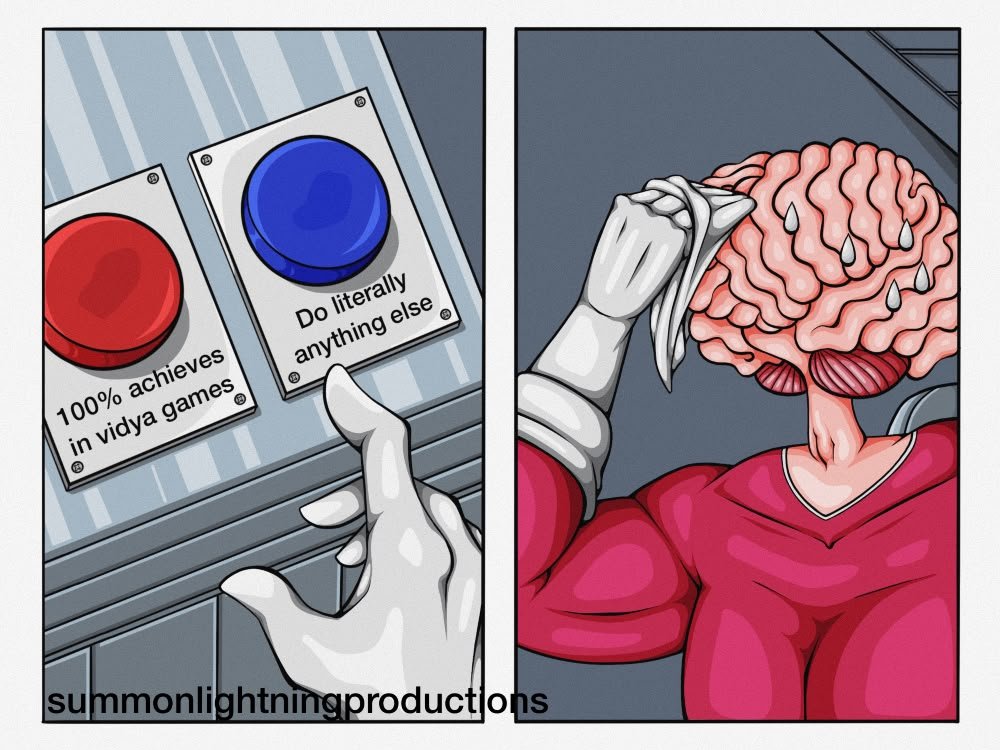
The above image is outdated. We’re way past sweating.
I. The Inciting Incident
I've gone and done it. Over $400 dropped on what amounts to a gimped computer.
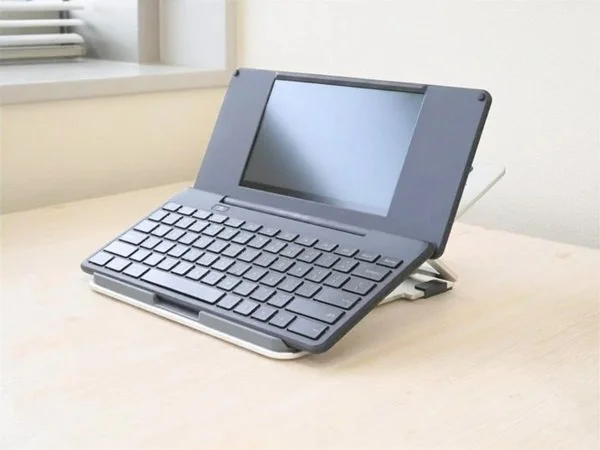
Featured Above: More useful than a typewriter, way less fun.
And why? What does this thing even do? Well, you can type on it. You can erase what you typed. Um. Let me check my notes. . .
. . . yeah, that’s about it.
“That’s it? So you spent almost the same amount as you could on a cheap laptop for a device with fewer features, a lower resolution screen, and a worse, more cramped keyboard so that—what? you could feel more writerly? So you could imagine you’re Robert W. Chambers in the late 1800s, banging out his final draft of the romantic-adventure Maid-at-Arms set during the era of the Civil war? Couldn’t you have just bought an actual computer and turned off the wifi if you were so desperate to reduce distractions?”
Well, therein lies the idea, right? The device is meant to be single-purpose, and no substitute will do. The claim here seems lofty, I recognize that. Buying a less useful device, at a very high cost? You’ve already asked why. Let’s dig into the reasons.
There’s a common phenomenon with modern gaming.
This is relevant, I promise.
There’s plenty to say, but I could sum up most of the problem in a single picture.
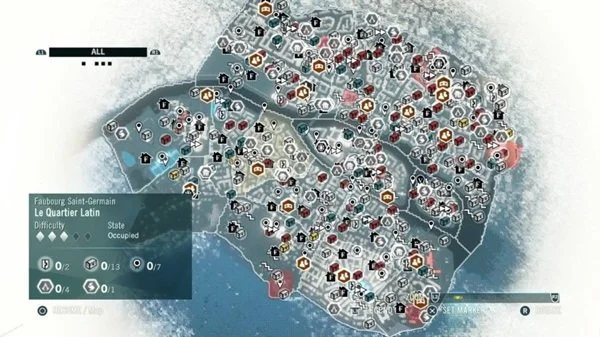
Seen Here: Innovative gameplay.
What do most of us do when we see that? There are three types of people who will all react differently:
1. The first type of person immediately begins completing every single objective on the entire map, intentionally ignoring any main story markers along the way until every of the dozens of missions, tasks and side-quests have been completed. This person may or may not even bother continuing the story after this due to burn-out. He might even return to the game months later, only to restart because he can’t remember what happened, whereupon the entire collect-a-thon will begin again. This either ends in him pushing through and beating the game with many middling impressions, or in total abandonment. “I’m sure it’s good,” he might say in a subsequent Youtube video, “but I couldn’t get past all the optional content.”
2. The next type of person has a more methodical approach: First, he turns off the icons. Secondly, he plays the game as normal, doing whatever missions catch his eye as he proceeds to explore the world. Third, he completes the game, along with whatever number of optional missions and quests that he encountered through normal game-play.
This person is a sociopath.
3. Finally, there’s the over-thirty-five group, a demographic whose impressions of modern gaming is transferring to younger and younger players every year. We’re the type who fire up the game, eager to immerse ourselves in a world of fantasy and adventure after a long and laborious day of our childhood dreams being ridiculed by the doldrums of reality. We open the map. We close the map. We close the game entirely.
We do something else.
Anyone who didn’t laugh at number 2 “because, I mean, who is even like that?” is the kind of person who also won’t understand why a dedicated writing device might justify its existence.
III. The Science
This is the bit where we answer the specific criticism: “Since you’re dropping $450 anyway, why not just buy a real laptop and turn off the wifi?”
The best way to explain a thing is generally to explain a totally different, completely unrelated thing, and then tie the two tenuously together with a robust logic.
So. Cookies. I love them, you love them—everybody loves them. What we don’t love are the excess calories and lack of nutrients, so they have to be seldom made and rationed out. Sometimes we make too many though, and the only thing to do is exert raw willpower. This would actually work, too. . . if not for the fact that cookies are psychic.
The normal strategy to avoid overeating sweets is through enacting the classic adage, “Out of sight, out of mind",” but cookies, they don’t play that game. Via extra-sensory perception, they are able to extend themselves out, through walls and distance, and connect with your mind. “Hey,” they say, directly into your brain, “remember me? I just want to remind you that whatever you’re doing is only a sorry procrastinatory distraction from me. Whatever dopamine trickle you’re getting from writing, drawing, studying, reading, working out, gaming or learning a new skill is a paltry, wispy substitute for the enormous chemical hit you’ll have once you stop lying to yourself, stop these pathetic and transient efforts that we both know are going to fail. Now stop wasting time, stop bleeding willpower, come into the kitchen, and eat me!”
In this case, cookies would be literally any distraction on your laptop—text messaging, Discord, emails, shopping websites, forums, the vast wealth of knowledge spanning the entirety of human knowledge, videos, video games, et al—and “walking into the other room” and “distractions from the cookies” would be the equivalent of turning off the wifi or “locking out” or uninstalling programs, setting a timer, et cetera. And they’re about as effective. Which is to say, I have legs and can cover the twenty feet between my room and the kitchen in an impressively short amount of time. The cookies never stood a chance.
Neither did my diet.
So telling someone to “turn off the wifi” is the equivalent of telling a junk-food junkie to “just go do something else.” If the solution for us fatties was to simply stop eating, we’d have been thin a long time ago. No. No, we’d have been happy a long time ago; we’d have achieved what so many others have achieved so easily, or never even lost, and could stop looking with disdain at ourselves every time we passed the taunting jabs of a reflective surface; we’d have been able to start wearing those clothes we criticized others, who looked so much better than we, for not wearing them; we’d have gone to those parties, talked to those girls, engaged more. Smiled more.
Sorry, I got personal, there.
I know I entitled this section “The Science,” but most science through history has been reasoned out foremost, and experiments were just the slamming down of the football long after the touchdown line had been crossed. (If that is not the correct nomenclature then I apologize; I know nothing of football.)
IV. The Solution
The next obvious criticism is that this is just another one of those toys that dreamers buy, gazing skyward with unfocused eyes, thinking that, when we finally have it in hand, it will transform us from lazy, unproductive wastrels into hyper-productive workhorses.
Well, it certainly isn’t outside the realm of possibility. It’s a device designed to provide no distractions: It has no applications, no internet access (except to do file transfers to get your documents onto a phone or computer), minimal customization of font, and it even avoids the inclusion of that painful productivity-killer, the mouse. Indeed, that’s part of the charm and point: It doesn’t have a mouse because it’s not a laptop, it’s not a PC: It’s a writing machine. You write. You don’t spend hours clicking around like some personal-computer zombie. You type and then you upload that to a computer.
But if you don’t have the will to utilize it, if you don’t take it to a coffee shop where your environment is clear of additional distractions, if you can’t make yourself open it up and sit in front of it, if you give yourself excuses—and even non-creatives are excellent at constructing complex webs of excuses—then the device will do nothing for you. You still need to bring something to the table yourself, fair exchange and all; only then will this device be allowed to work its distraction-less magic.
V. As for Me
It will be arriving next week, provided nothing goes wrong, and I have resolved to make every effort to make it work, even if it means I have to alter my workflow to some degree. I love, love, love the idea of sitting down to a dedicated hardware Word Processor, a “digital typewriter,” with all of its writing-focused tools at my disposal, and having nothing but the writing to do. I recognize that this is, in some ways, a fancy, a whim, a lovely little picturesque illustration in my head of an ideal writing situation, a mood.
But it’s one I dearly want to realize.