Anime Review: Maesetsu! Opening Act
The jokes sometimes land. The show never lands.
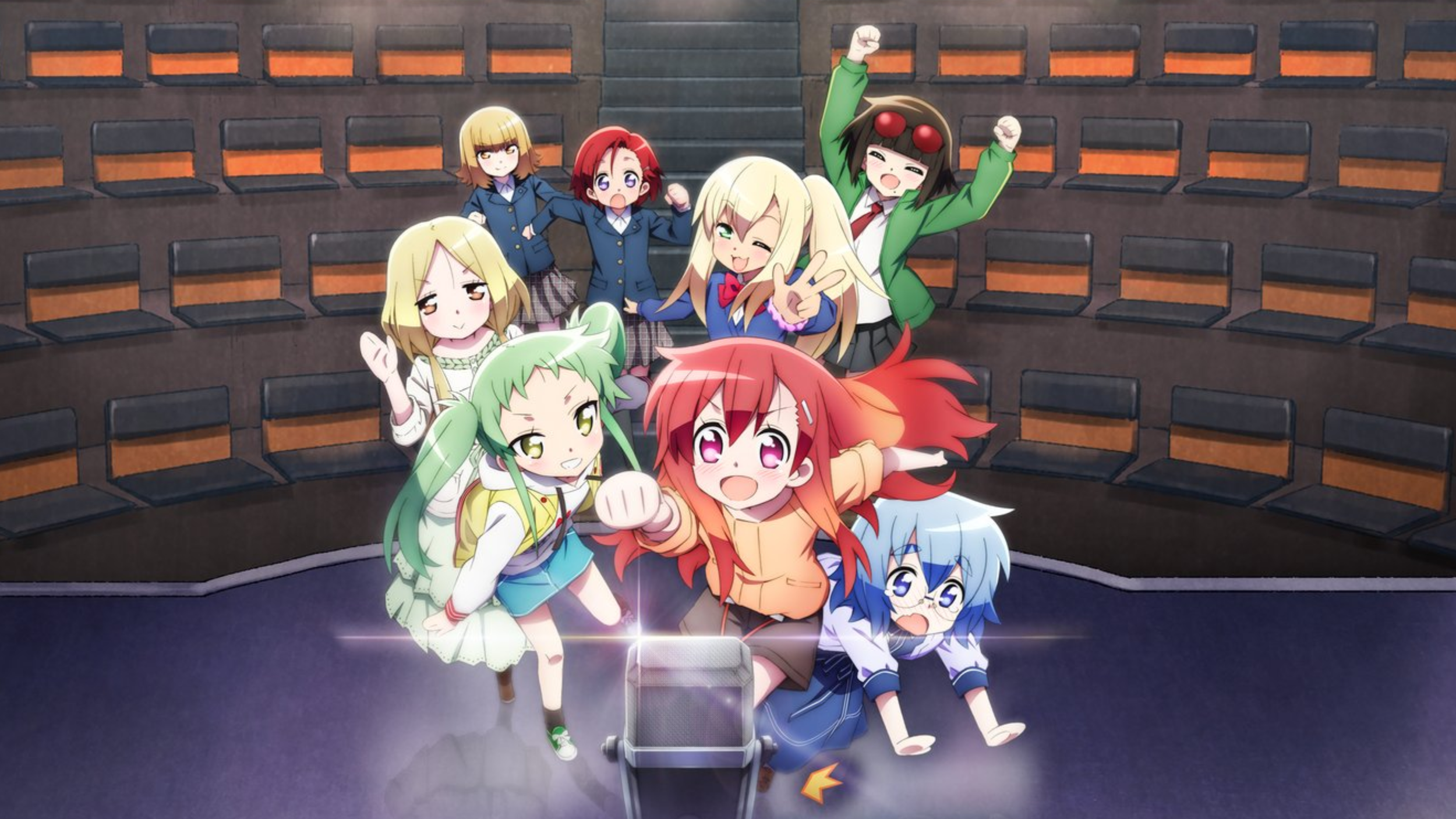
Pictured above: The most exciting scene in the show. It’s the cover art.
I. What’s This Show About?
I guess you don’t really need me to tell you. Just read the blurb. It’s what it says on the tin: A show about primarily four characters, equaling two comedy duos, who work part-time, I think go to college (it’s rarely mentioned after the first episode) and have part-time jobs as they try to build a comedy career.
We used to have Abbott and Costello and their ilk. The Japanese took that concept and ran with it, so that “the comedy duo” is a standard comedic formula.
In Opening Act, the Japanese have done the thing that the Japs always do: take a male-dominated thing and just insert cute girls in it. That’s not a criticism, incidentally, if they stopped doing it I’d personally ensure a rise in terrorism across the globe. The only thing as interesting as women and girls doing things that are normally done by adult men, is children in general doing these things, be it launching model rockets, owning a business, DIY-carpentry or stand-up comedy; if you just make it children or women doing it, for some reason it becomes much more interesting. Maybe it’s just a certain demographic that likes this contrivance. All in favor? My hand’s up.
II. Is It Good?
It’s O.K.
A lot of people are going to tell you that it’s “bad,” but I think that’s. . . well, I think that’s a fine assessment if you just want to know if you should bother with it or not. The fact is, although I wouldn’t call it “bad,” and if I could go back in time to not watch it I wouldn’t waste the plutonium, I would say that a fair conclusion is to say that it’s “not recommended.”
The characters are fine, the art is solid, there are a couple-dozen excellent moments throughout the 12-episode season; the premise is interesting and there’s a promising execution. It’s an anime that does so much right that when people don’t like it they tend to be at a loss for why, so they resort to saying it’s bad, or it’s alright, or it’s not interesting. I guess that’s sufficient. If ten-thousand people are saying it’s dull, then it’s a good bet you’re not going to enjoy it either; however, if you do want more specifics, then here are my thoughts.
III. So What’s Wrong With It, Specifically?
Before I make any criticisms, I want to insist that any one of these problems by itself might either be forgivable, not a problem at all, or even a benefit, in the right circumstances. If I mention something and you can think of a masterpiece that has the same “issue,” then keep in mind that it’s a collection of problems.
That said, I think most of the issues here are obvious issues, and I’d be surprised if anyone tried to debate the point more than half-heartedly.
First is the characters. This is one of those problems that many very good cartoons have, and it’s that you don’t have a strong sense of why the characters are the way they are. There’s no justification for why one should be almost like nobility in her speech patterns and pronunciation, and another should be nothing like that. Shoot, even people who come to the United States illegally are usually speaking perfect, un-accented English within one or two generations. When’s the last time you heard someone who had a “Harvard dialect”? Maybe in Japan things are drawn more distinctly, but then you’d think there’d be a lot of ado about it. They certainly make much of people with an Osaka dialect, yet someone who speaks with the lofty tones of the economic elite gets no remark whatever?
Related to the characters are the emotional plot-lines. Every slice-of-life and drama must have at least a few episodes where the characters openly weep about something, and I anticipate these moments with great excitement. I’m not sure if this makes me feminine or sadistic, or if there’s a difference between the two.
In this show there are two big emotional character moments. One of them happens with the main character’s sister after they fail to pass the preliminaries for a stand-up competition. She sulks for three or four days, eats very little, is reticent at large and just makes everyone worry about her. The resolution here, which is perfectly fine conceptually, is that she feels like she roped her friend into doing their little act, then wasted her time by failing. As it turns out, her friend was enjoying things the whole time and it’s all cool. They get back on the horse and keep riding.
The problem is that, right up until the exact point that she and her friend have the heart-to-heart, there’s no explanation or clue as to what specifically is bothering her. Failure after hard work is tough—heck, I’m going through that right now—and needing to emotionally recoup for a couple days or even more isn’t crazy. The show doesn’t use that as the explanation though, which I think would have been more powerful. It instead suggests that she’s got all these concerns about her friend, which are all hashed out in one short, poignant conversation that leaves you feeling like the whole thing was half-baked.
This same kind of thing happens with the other major character moment, in which the protagonist’s partner is losing confidence and is upset about “something,” but in classic anime fashion, every time someone asks her what’s up she just says, “It’s nothing.” No, it ain’t “nothing,” and we can all see that. You’re practically begging people to ask you what’s wrong by the way you’re looking down with those forlorn eyes, sighing and moping. After two episodes of all of this unspoken inner-turmoil, the problem turns out to be that she, and the protagonist after, both feel that they’re holding each other back.
Only the show never really shows them holding each other back. There’s nothing about this anywhere. It’s just brought up right at the point of climax, and then everything’s resolved within a few minutes of screen-time. If that isn’t bad enough, it turns out that the protagonist and her comedy-duo friend are in the wrong positions: the protagonist, as a natural clown, should have the “comedy” role, while the more reserved character should naturally have the “straight man” role. This is such a perfect idea for a blunder that the show should have been exploring it for three or four episodes.
Check it:
If I told you that the arc was about how they felt like something wasn’t quite right but they weren’t sure, and each character felt like they weren’t getting the pacing right, and that some other characters, multiple throughout the episodes, kept mentioning things like, “Oh, Protagonist, you’re so silly and quirky when we’re talking here, but you play the straight man on stage? That’s funny.” But the characters refused to acknowledge this, at first because they don’t really think anything of it, and then because they don’t like to think that they’ve made such a huge tactical error, and then because they don’t want to give up their roles. Finally, after an existential crisis, they change places and find that they only suck for a little bit while adjusting, and then they’re really good, and this creates one last problem as they are frustrated with this idea that they are “supposed to” do it this particular way because of their “natural personalities”: Why shouldn’t I be able to be the straight man? It’s all in the practice and the technique, right? I put all this effort into being the straight man without success, and now just because I’m the joker suddenly our act is good? Screw that noise!
Then they get over it and start doing better. Doesn’t that sound like the real plot? Doesn’t that sound like what you’d expect? Well, it ain’t what you get. Basically none of that happens. At the eleventh hour they are told, “Hey, you seem like you should be the straight man, and you should be the comic,” and they switch and that’s about it. The end.
There’s something to be said for brevity, and for not dragging something out for seasons (looking at you, SNAFU), but for pity’s sake, this show put basically no effort into developing the dramatic situations. It’s no wonder that the consensus is that the show is dull.
IV. Well, Except That One Part
There is one bit that plays out pretty much perfectly. The characters do a stand-up show on a tiny little stage in a sitting-room in a bathhouse (or is it an inn?), and both of the duo’s acts bomb because they have a crowd of old people from a remote town. These people don’t relate to their big-city topics.
After spending an entire day checking out the tourist sites and eating the local cuisine, as well as getting some good advice from their friends who have been doing stand-up for much longer, the girls all write some fresh material to appeal to this specific audience. Their next show is a hit and gets a lot of laughs.
That’s the kind of progression I wanted to see in every aspect of the story.
V. Wrap-up
Despite the flaws in, primarily, storytelling, the show still has the nice music, pleasant art-style, relaxing slice-of-life “nothing going on” scenes, cute characters, standard anime-style comedy and, in truth, a few stand-up bits that work. (I liked the role-play bit with the cicada coming back to thank someone for saving it.)
I’ll never watch it again, and I wouldn’t really recommend it to someone unless they were completely out of stuff to watch and are into the style, but I’m more or less glad I watched it and I’m finding it sticking with me, somehow.